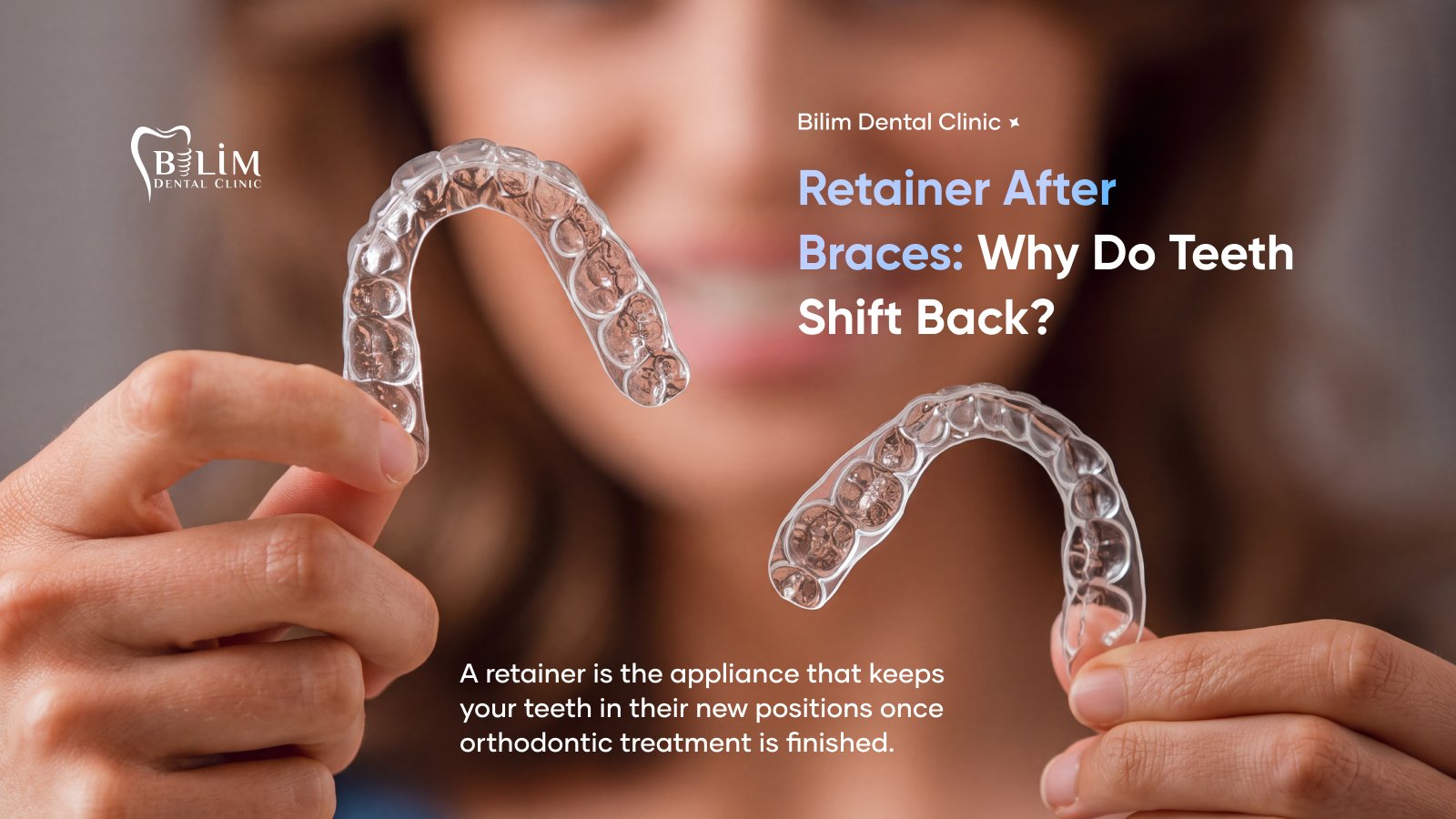
A retainer is the appliance that keeps your teeth in their new positions once orthodontic treatment is finished. For most patients, the day the braces come off feels like the end of treatment. Months — sometimes years — of work are complete, the teeth are straight, and the smile looks the way it was meant …
A retainer is the appliance that keeps your teeth in their new positions once orthodontic treatment is finished. For most patients, the day the braces come off feels like the end of treatment. Months — sometimes years — of work are complete, the teeth are straight, and the smile looks the way it was meant to. In an orthodontist’s eyes, though, that day marks the start of the longest and arguably most important phase.
When it comes to wearing a retainer, there is one sentence we hear often in the clinic: “I had braces, but my teeth have gone crooked again.” In almost every one of these cases, the problem lies not in the treatment but in what came after it. The appliance was not worn regularly, was not replaced when it broke, or was abandoned because it no longer seemed necessary.
In this article, the dentists at Bilim Dental Clinic in Maltepe, Istanbul explain why teeth try to return to their old positions, the different types of retention, how long they need to be worn, and how to look after them.
What Is a Retainer and Why Is It Needed?
During orthodontic treatment, teeth are moved slowly through the bone. As a tooth moves, bone is broken down on one side and rebuilt on the other. When the braces come off, this new bone has not fully matured, and the structures holding each tooth in place are still reorganising.
The retention phase is the time these structures need to adapt. A retainer holds the teeth where treatment left them while that happens. Without one, teeth can move back toward their original positions, especially during the first months.
Put simply: braces move the teeth into place, and retention keeps them there. They are two halves of the same treatment.
Why Do Teeth Shift Back?
Relapse after treatment has no single cause. Several forces act at the same time.
The “Memory” of the Gum Fibres
Within the gum are elastic fibres connecting each tooth to its neighbours and to the bone. When a tooth is moved, these fibres are stretched. The bone adapts within a few months, but some of the fibres at gum level need much longer — a year or more — to remodel. Throughout that time they act like elastic bands, pulling the tooth back toward where it started. Teeth that have been rotated are particularly prone to this.
Pressure From the Tongue, Lips, and Cheeks
Teeth sit at a point of balance between the tongue on the inside and the lips and cheeks on the outside. Tongue thrusting, lip biting, thumb sucking, or mouth breathing can all upset that balance. If one of these habits contributed to the original problem and continues after treatment, the teeth will be pushed in the same direction again. We explain the effect of childhood mouth breathing on jaw development in our article on mouth breathing in children.
Growth and Ageing
Although jaw growth largely finishes in adolescence, small changes — especially in the lower jaw — can continue into the twenties. Beyond that, teeth naturally tend to drift slightly forward with age, and the lower front teeth tend to crowd. This happens in people who have never had braces, too. Teeth move throughout life, treated or not.
The Bite
The way the upper and lower teeth fit together creates forces that push teeth in particular directions. A well-balanced bite at the end of treatment supports stability; an unbalanced one creates forces that work against it.
Clenching and Grinding
Night-time clenching places heavy forces on the teeth and strains both their positions and the appliance. For patients who grind, the retention plan is adapted accordingly; you can read more in our guide to tooth grinding and clenching.
A note on wisdom teeth: for many years, erupting wisdom teeth were blamed for pushing the front teeth and causing crowding. Current research suggests their role is much smaller than once thought. Wisdom teeth are not removed simply to “protect the alignment”; that decision rests on other clinical grounds.
Fixed or Removable: Types of Retainer
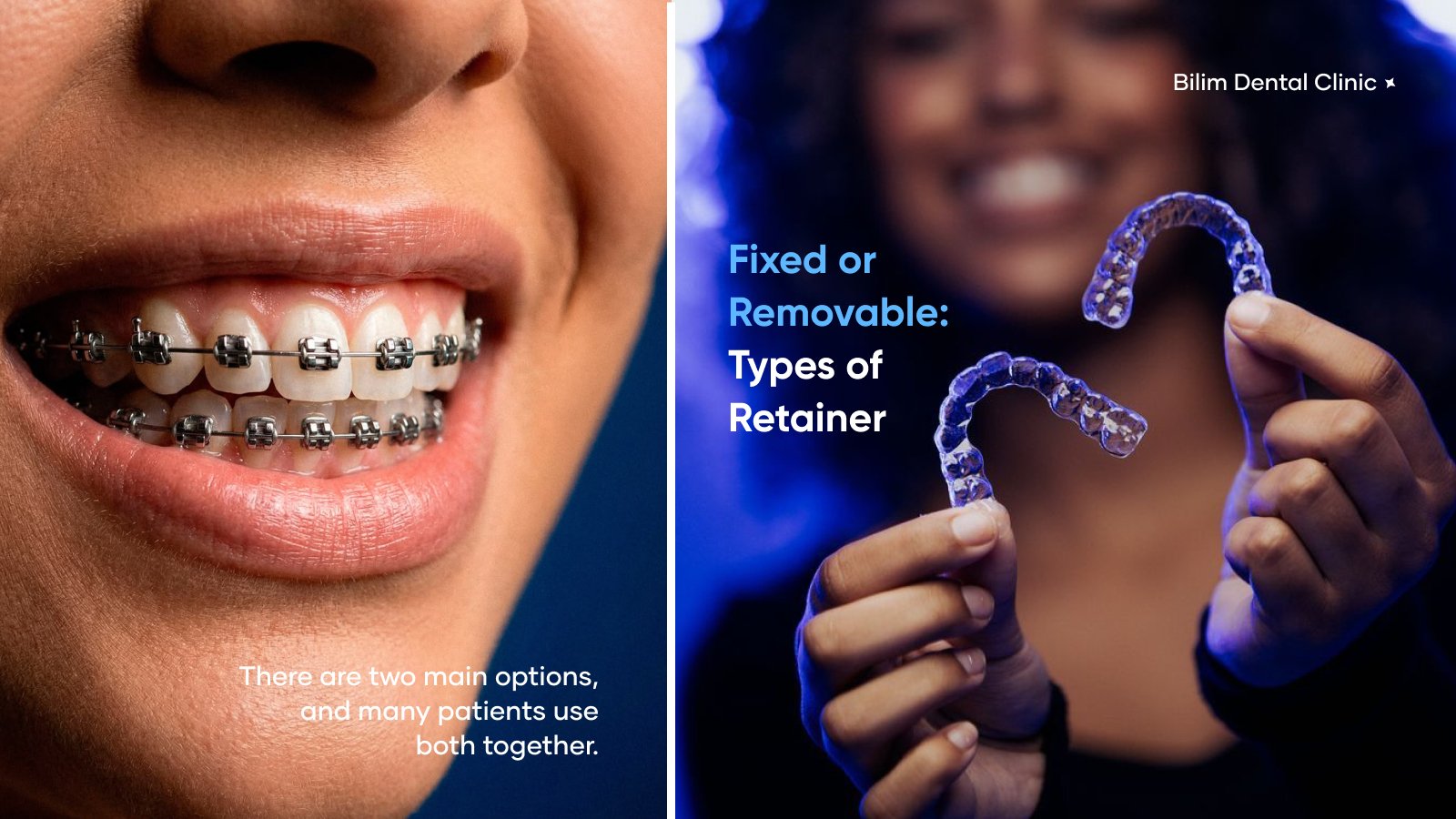
There are two main options, and many patients use both together.
| Feature | Fixed (Bonded) Wire | Clear Removable Retainer | Hawley Retainer |
|---|---|---|---|
| Structure | Thin wire bonded behind the front teeth | Thin, transparent plastic fitting over the teeth | Acrylic plate with a metal wire across the front teeth |
| Visibility | Invisible from the front | Almost invisible | Wire visible at the front |
| Relies on the patient? | No, it is always in place | Yes, must be worn consistently | Yes, must be worn consistently |
| Cleaning | Needs special techniques; plaque and tartar build up more easily | Removed and cleaned; oral hygiene is easy | Removed and cleaned |
| Possible problems | A debonded point may go unnoticed | Cracking, wear, loss | Breakage; affects speech for the first days |
| Best suited to | Lower front teeth, rotated teeth, closed spaces | Many cases, alone or combined with a fixed wire | Some cases where bite adjustment is needed |
Evidence suggests bonded wires are slightly more effective at maintaining the alignment of the lower front teeth, while the success of removable appliances depends entirely on how consistently they are worn. On the other hand, gum health tends to be better with removable options. That is why many orthodontists combine them — a bonded wire on the lower front teeth and a clear appliance on the upper, or bonded wires on both arches plus a night-time appliance. The right choice depends on your situation before treatment.
How Long Should You Wear a Retainer?
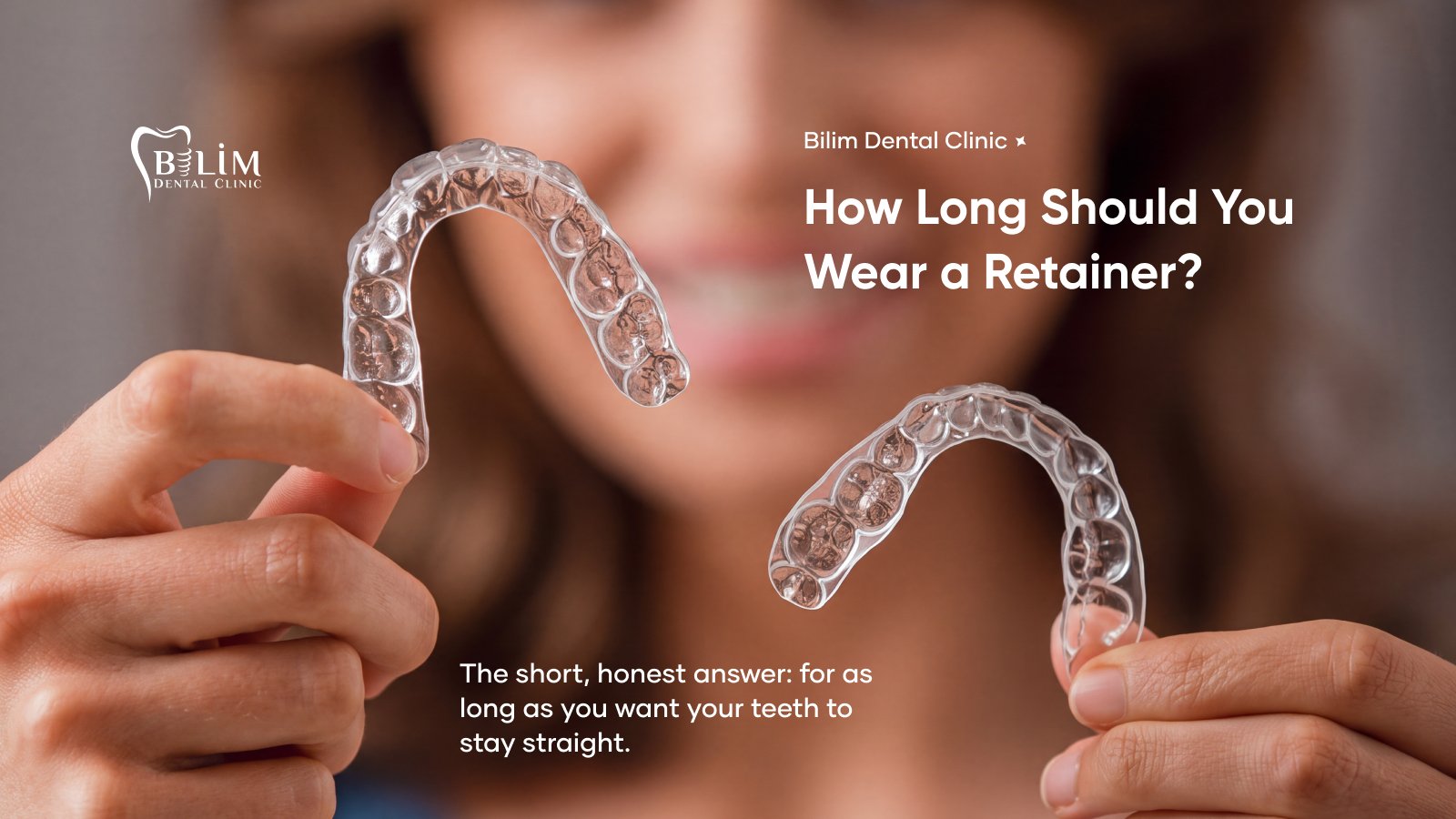 The short, honest answer: for as long as you want your teeth to stay straight.
Modern orthodontics treats retention as lifelong. That does not mean wearing something all day for the rest of your life — the amount of wear reduces over time. A typical schedule looks like this:
- Initial phase (usually the first few months): all day except for eating and brushing, or every night, depending on your orthodontist’s advice
- The following months and first year: every night
- Long term: a few nights a week, as your orthodontist assesses
Schedules vary between patients, and some research suggests that in the right cases night-time wear can be as effective as full-time wear. What matters is changing the schedule together with your orthodontist at review appointments, not on your own.
Long-term follow-up studies show that a substantial proportion of patients who wear their appliance for only a year or two experience significant relapse over the following years. When a retainer is not worn, the movement is rarely overnight — it happens slowly enough to go unnoticed, and patients usually only realise when a shift in the front teeth becomes obvious.
Missed a Night — Is That a Problem?
A very common question. Forgetting for one or two nights rarely causes serious trouble. When you put the retainer back in, it may feel slightly tight; that means the teeth have moved a tiny amount and are being guided back. The feeling usually fades within a few nights.
Contact your orthodontist, however, if:
- The appliance no longer fits, or you have to force it into place
- You have not worn it for several weeks or longer
- The tightness does not ease after a few days
Forcing an appliance that no longer fits can damage both the teeth and the appliance. Your orthodontist can assess the change and recommend a new retainer or a short corrective treatment.
Warnings for Patients With a Bonded Wire
Because a bonded wire is invisible and requires nothing from the patient, it is easy to forget — and that brings its own risks.
When one of the bonding points comes loose, patients often do not notice. The tooth at that point is then free to move. If you feel a rough spot, a change, or movement behind your front teeth with your tongue, arrange a check-up without delay.
Cleaning also needs extra attention. Plaque and tartar collect easily between the wire and the teeth and can lead to gum inflammation, particularly around the lower front teeth. Superfloss, floss threaders, and interdental brushes are recommended for this area, and regular professional cleaning matters even more. Good general brushing habits help too — see our guide to toothbrush replacement and brushing technique. If you notice bleeding gums around a bonded wire, an assessment within periodontal treatments is worthwhile.
Daily Care and Cleaning
To protect your retainer’s lifespan and hygiene, follow these rules:
- Rinse it every morning with cool or lukewarm water and clean it gently with a soft brush
- Never use hot water — the plastic can warp and may never fit again
- Avoid scrubbing with toothpaste — abrasive paste scratches and clouds the plastic
- Drink nothing but water while it is in — sugary or acidic drinks trapped against the teeth raise the risk of decay and erosion
- Always put it in its case when you take it out — appliances wrapped in napkins are the ones most often lost or thrown away
- Keep it away from pets — dogs find the smell appealing and will chew it
- Bring it to every review appointment — your orthodontist will check the fit and wear
Clear retainers wear and cloud over time, and their lifespan depends on how they are used. Replace yours if you notice cracks, holes, or a poor fit.
The First Few Weeks
In the first days, a new retainer can feel like a foreign object. That is entirely normal. You may notice slight pressure, extra saliva, and small changes in some sounds for the first few nights. The tongue and lips adapt within days.
A few tips make the adjustment easier:
- Practise putting it in and taking it out at the clinic on the first day; learning the right technique prevents breakage
- Seat it with your fingers — do not bite it into place
- When removing it, work evenly from both sides starting at the back teeth rather than pulling from one side
- Reading aloud with the appliance in helps speech return to normal quickly
- Putting it in at the same time every night helps it become a habit
If you notice gum irritation, a sharp edge, or marked pain in the first weeks, the retainer needs adjusting. Do not try to file or trim it yourself; a small adjustment at the clinic takes only minutes.
Lost or Broken Retainer: What Should You Do?
The most important rule is not to wait. Every week without retention is a chance for the teeth to move.
If your retainer breaks or is lost, contact your clinic as soon as possible. If you have a spare retainer, wear it until the new one is ready — which is why many orthodontists recommend having a second appliance made. A new impression or digital scan is usually needed. If a broken appliance still fits and stays in place, ask your orthodontist whether you can keep wearing it until the replacement arrives.
My Teeth Have Already Moved — What Can Be Done?
If neglected retention has allowed teeth to shift, the situation can usually be corrected. For small shifts, an existing appliance can sometimes guide the teeth back gradually — but only under your orthodontist’s supervision. More noticeable changes may need a short course of clear aligners or a limited course of fixed braces.
The plan depends on how much relapse has occurred and which teeth are affected. After correction, retention needs to be followed far more consistently than before.
Retention in Teenagers: The Family’s Role
Teenagers who finish treatment during adolescence are the highest-risk group for relapse. There are two reasons: jaw growth has not fully finished, and motivation drops quickly once the braces come off. After months of living with an appliance, wearing one at night can feel at odds with the sense that “treatment is over.”
Family support makes a real difference. Keeping the case by the bed, making it part of the bedtime routine, and putting review appointments in the calendar are simple but effective habits. It also helps to create an atmosphere where a teenager feels able to say straight away that the appliance is lost or broken; losses discovered late often mean extra treatment.
For school trips, camps, and residential activities, remember to pack the retainer. A break of a few weeks can undo part of years of effort.
Other Factors That Affect Long-Term Stability
Wearing your retainer consistently is the most important factor, but not the only one.
Gum health: gum disease weakens the supporting tissues and makes teeth easier to move. Especially in adults, gum check-ups should not be skipped during retention.
Controlling habits: as long as tongue thrusting, lip biting, nail biting, or chewing pens continue, the pressure on the teeth continues.
Replacing missing teeth: when a tooth is extracted and the gap is left, neighbouring teeth tip into the space, which can undo the alignment quickly.
Regular check-ups: orthodontic reviews should continue after treatment ends. At Bilim Dental Clinic, we recall patients at set intervals after their braces come off to check the fit of their appliance and monitor any changes in their teeth.
Frequently Asked Questions
Do I really need to wear a retainer for life?
If you want your teeth to stay straight, yes — but wear can reduce over time to a few nights a week. Your orthodontist will set the exact schedule.
If I have a bonded wire, do I also need a removable appliance?
In some cases, yes. A bonded wire holds only the teeth it is attached to; a night-time appliance may be recommended for the other teeth or the opposite arch.
Is it hard to talk with one in?
There may be a slight lisp for the first few days. The tongue adapts quickly, and with clear appliances the effect is usually minimal.
Can I eat with it in?
No. Removable appliances should be taken out for meals. Only water should be drunk while wearing one.
How often should it be replaced?
It depends on how it is used. It should be replaced when it shows wear, cracking, discolouration, or no longer fits; your orthodontist will assess this at reviews.
Do patients treated with clear aligners also need retention?
Yes. Whatever method was used to move the teeth, the need for retention is the same.
Can a bonded wire damage the gums?
When cleaned properly it usually causes no problems. If cleaning is neglected, tartar and gum inflammation can develop around it.
When is a bonded wire removed?
It often stays in place for many years. If it needs to be removed, a night-time appliance is usually made to replace it.
My teeth ache when I put it in — is that normal?
Slight tightness is normal after a period without wearing it. Marked pain or a poor fit may indicate that the teeth have moved; contact your orthodontist.
Is there an extra charge for retention?
This depends on the clinic’s treatment plan and the type of appliance. It is best to ask about spare or replacement costs before treatment begins.
Orthodontics and Retention Follow-Up in Maltepe

The effort that goes into a straight smile only lasts with discipline after treatment. In this article we answered the questions our orthodontic patients ask most: why teeth shift back, the difference between bonded wires and clear appliances, how long to wear them, and what to do if one is lost or broken. For an overview of treatment options, visit our orthodontic treatment page, and for cosmetic finishing after orthodontics, see smile design.
At our clinic, we provide services in all areas of oral and dental health — from aesthetic dentistry and implant treatments to orthodontics and prosthetic applications — using modern technology and evidence-based, scientific approaches. Our experienced team of dentists creates a personalized treatment plan for every patient, aiming to build healthy, natural, and aesthetic smiles.
The dentists who will accompany you throughout this process:
- Dt. Ali Enes Öztürk
- Dt. Salman Taştan
- Dt. Hüseyin Kaya
- Uzm. Dt. Burak Güleç (Orthodontics Specialist)
- Dt. Cem Karaman
- Dt. Ayşe Sizer Çakar
- Dt. Zeynep Ece Okur (Pediatric Dentist)
For a retainer check, a replacement, or any change you have noticed in your teeth, we invite you to visit Bilim Dental Clinic on Bağdat Caddesi in Maltepe, Istanbul. You can follow our latest updates on our Instagram account.
WhatsApp: +90 538 977 89 01