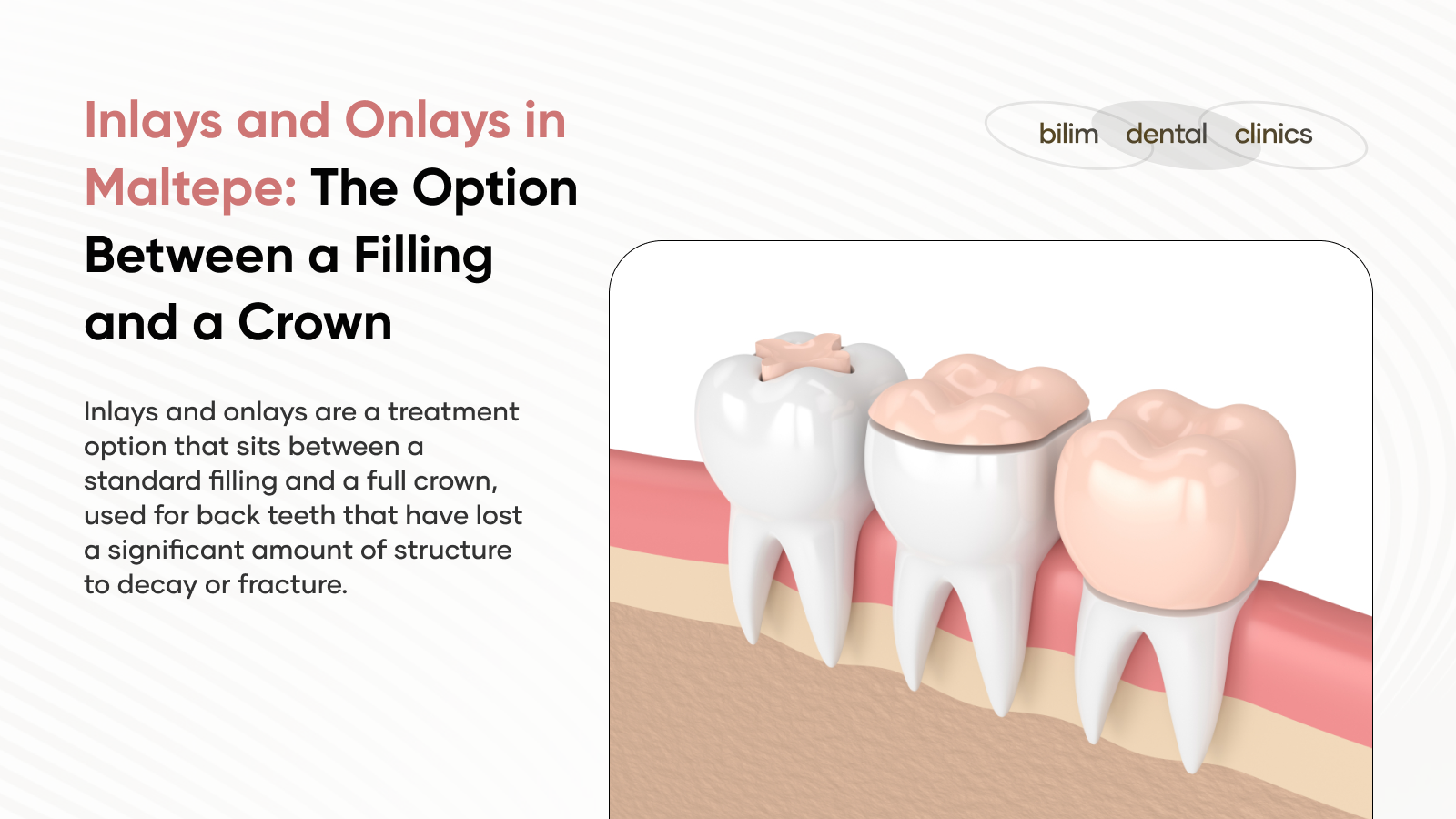
Inlays and onlays are a treatment option that sits between a standard filling and a full crown, used for back teeth that have lost a significant amount of structure to decay or fracture. Unlike a filling, which is shaped directly in the mouth, an inlay or onlay is made as a single piece — in …
Inlays and onlays are a treatment option that sits between a standard filling and a full crown, used for back teeth that have lost a significant amount of structure to decay or fracture. Unlike a filling, which is shaped directly in the mouth, an inlay or onlay is made as a single piece — in a dental laboratory or with digital systems — after the tooth has been measured, and is then bonded to the tooth. They are sometimes called “porcelain fillings” or “partial crowns”.
Patients usually meet this option at a familiar moment: the damage is too large for a filling, but it is too early to crown the whole tooth. Inlays and onlays fill that middle ground while preserving as much healthy tooth as possible.
In this article, the dentists at Bilim Dental Clinic in Maltepe, Istanbul explain the difference between an inlay and an onlay, when each is used, how the treatment works, and how it compares with fillings and crowns.
What Are Inlays, Onlays, and Overlays?
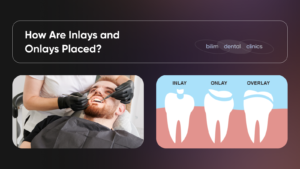
All three terms describe partial restorations that are made outside the mouth and bonded to the tooth. The difference is how much of the tooth they cover:
Inlay: fills the space between the cusps (the raised points on the biting surface) without covering any of them. It resembles a large filling, but is made in one piece.
Onlay: fills the space and also covers one or more cusps. It is used to protect weakened cusps from breaking.
Overlay: covers the entire biting surface. It is the option closest to a crown, but the side walls of the tooth are still preserved.
A full crown, by contrast, wraps around the whole tooth, which means reducing every surface.
When Is an Inlay or Onlay Recommended Instead of a Filling?
A composite filling works very well for small and medium-sized cavities. As the damage grows, however, the limits of a filling built up layer by layer in the mouth become clearer. With large fillings it is harder to create ideal contact points with neighbouring teeth, shape the biting surface accurately, and make sure the filling withstands wear over the long term.
An inlay or onlay is usually considered for:
- Extensive decay or an old large filling covering much of the tooth
- A broken or cracked cusp
- Damage to large molars that take heavy biting forces
- Replacement of an old amalgam filling that leaves weak walls behind
- Root-canal-treated teeth whose walls are still strong enough not to need a full crown
For root-canal-treated teeth, the amount of remaining tooth structure decides. If the walls are seriously weakened, an onlay or overlay may not be enough, and a crown may be the safer choice.
Filling, Onlay, or Crown? A Comparison
| Feature | Composite Filling | Inlay / Onlay | Full Crown |
|---|---|---|---|
| How it is made | Directly in the mouth | Outside the mouth, after an impression or scan | Outside the mouth, after an impression or scan |
| Healthy tooth preserved | Most | A lot | Least |
| Suitable for | Small–medium damage | Medium–large damage | Very large damage |
| Number of visits | Usually one | Usually two (one with some digital systems) | Usually two or more |
| Protection of weak cusps | Limited | Good with an onlay | Very good |
What Are They Made Of?
Today, inlays and onlays are mostly made from ceramic or composite-based materials:
Ceramic (porcelain): very close to natural tooth in colour and translucency. Reinforced ceramics such as lithium disilicate combine aesthetics with strength. We discuss the same family of materials in our E-max veneers article.
Laboratory composite and hybrid materials: more flexible than ceramic and gentler on the opposing tooth. They are also relatively easy to repair in the mouth.
The material is chosen by considering the tooth’s position, the amount of damage, any night-time clenching, and the nature of the opposing tooth. If you clench or grind, a night guard may be recommended to protect the restoration — see our article on tooth grinding and bruxism.
How Are Inlays and Onlays Placed?
Conventional treatment usually takes two visits:
1. Preparation: under local anaesthetic, decay or the old filling is removed and the tooth is shaped so the restoration will seat precisely.
2. Impression or digital scan: the tooth is recorded with traditional impression material or an intraoral scanner.
3. Temporary restoration: a temporary filling protects the tooth while the final piece is made.
4. Fabrication: the restoration is made in a laboratory or with computer-aided design and manufacturing (CAD/CAM).
5. Bonding: at the second visit, the temporary is removed, the fit, contacts, and bite are checked, and the piece is bonded with specialised adhesives.
With chairside digital milling systems used in some clinics, the whole process can be completed in a single visit.
Advantages of Inlays and Onlays
They preserve healthy tooth: far less reduction is needed than for a crown, and the healthy side walls stay in place.
Better fit and contacts: because they are made outside the mouth, contact points and the biting surface can be shaped with more control than in large fillings.
No shrinkage problem: large fillings cured in the mouth can shrink slightly. A piece made outside and then bonded largely avoids this.
They strengthen the tooth: onlays in particular cover weakened cusps and reduce the risk of fracture.
Appearance: ceramic inlays and onlays blend with the natural colour of the tooth.
How Long Do They Last?
Research shows that ceramic inlays, onlays, and overlays perform well over the long term. A 2016 systematic review and meta-analysis found survival rates of around 95% at five years and around 91% at ten years. The most common reasons for failure were new decay at the edge of the restoration and ceramic fracture.
That is why the patient’s oral hygiene and regular check-ups matter most for how long a restoration lasts. Using floss or interdental brushes reduces the risk of decay at the margins.
When Are They Not Suitable?
- Small cavities that can easily be managed with a filling
- Teeth with very thin walls and most of their structure lost (a crown may be better)
- Poor oral hygiene with a very high ongoing risk of decay
- Severe, unmanaged clenching or grinding
Frequently Asked Questions
Is an inlay or onlay the same as a “porcelain filling”?
Yes. When people talk about porcelain fillings, they usually mean ceramic inlays and onlays.
Is the procedure painful?
Preparation is done under local anaesthetic. You should not expect more discomfort than with an ordinary filling.
How many visits does it take?
Usually two with the conventional method; with chairside digital systems it can be done in one.
Can an inlay or onlay come off?
When bonded correctly, it attaches very strongly to the tooth. Debonding is uncommon and is usually linked to contamination during bonding or excessive force.
Can they be used on front teeth?
Inlays and onlays are designed mainly for back teeth. Other options are preferred for front teeth.
Can a root-canal-treated tooth have an onlay?
Yes, if its walls are strong enough. If little tooth structure remains, a crown may be safer.
How is the cost determined?
It depends on the material, the type of restoration, and the condition of the tooth. Exact information is given after an examination.
Inlay and Onlay Treatment at Bilim Dental Clinic in Maltepe

Inlays and onlays restore heavily damaged teeth strongly and aesthetically without removing more tooth than necessary. In this article we answered the questions we are asked most: the difference between an inlay and an onlay, how they compare with fillings and crowns, material choices, and the steps of treatment.
At our clinic, we provide services in all areas of oral and dental health — from aesthetic dentistry and implant treatments to orthodontics and prosthetic applications — using modern technology and evidence-based, scientific approaches. Our experienced team of dentists creates a personalized treatment plan for every patient, aiming to build healthy, natural, and aesthetic smiles.
The dentists who will accompany you throughout this process:
- Dt. Ali Enes Öztürk
- Dt. Salman Taştan
- Dt. Hüseyin Kaya
- Uzm. Dt. Burak Güleç (Orthodontics Specialist)
- Dt. Cem Karaman
- Dt. Ayşe Sizer Çakar
- Dt. Zeynep Ece Okur (Pediatric Dentist)
For an assessment of a large filling or broken tooth, contact us or visit us — we invite you to visit Bilim Dental Clinic on Bağdat Caddesi in Maltepe, Istanbul. You can follow our latest updates on our Instagram account.
WhatsApp: +90 538 977 89 01