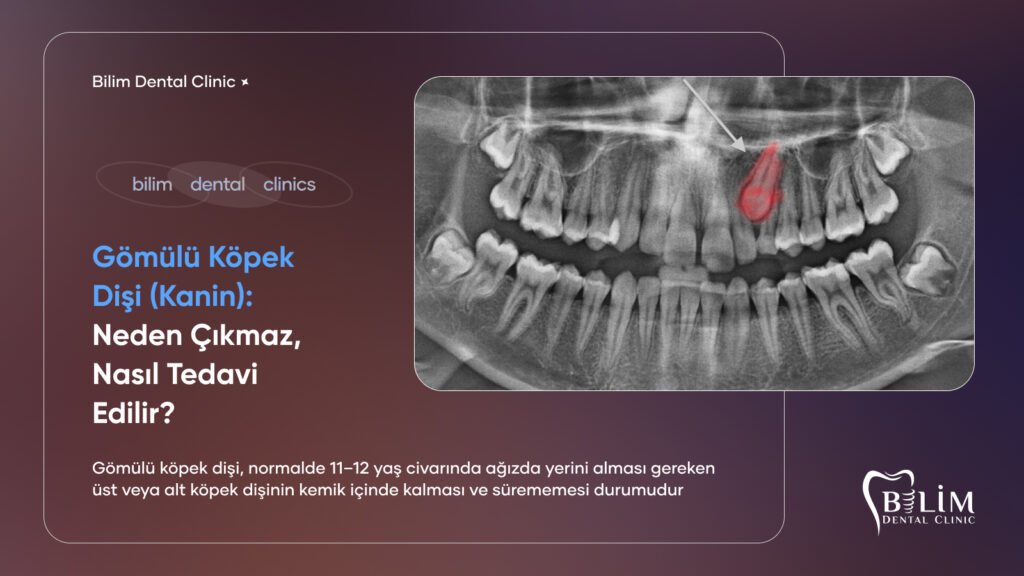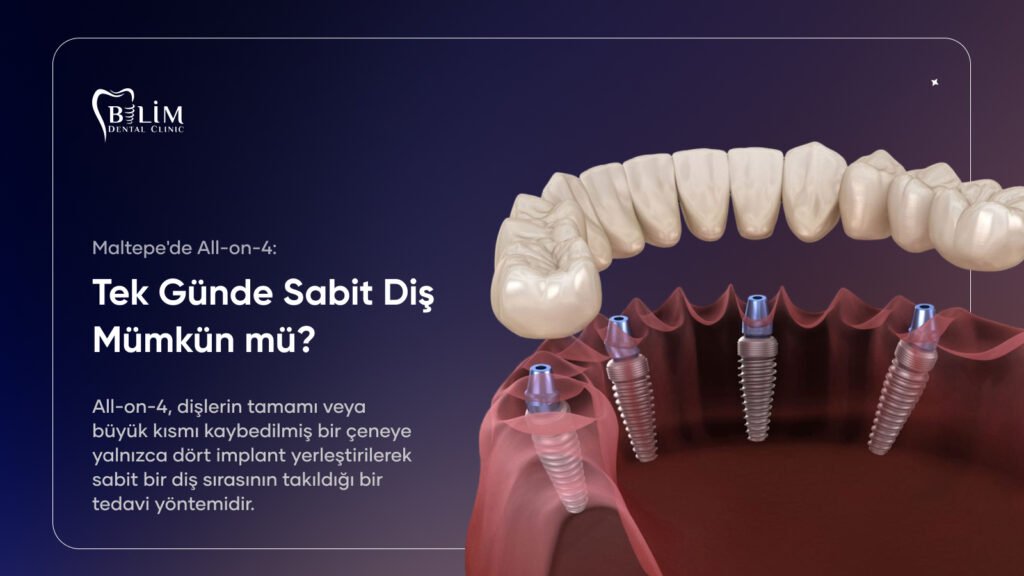
An impacted canine is a canine tooth that stays trapped in the bone instead of erupting into the mouth around the age of 11 or 12. After wisdom teeth, the upper canine is the tooth most often impacted. Families usually discover it when a baby canine is still firmly in place at 13 or 14, …
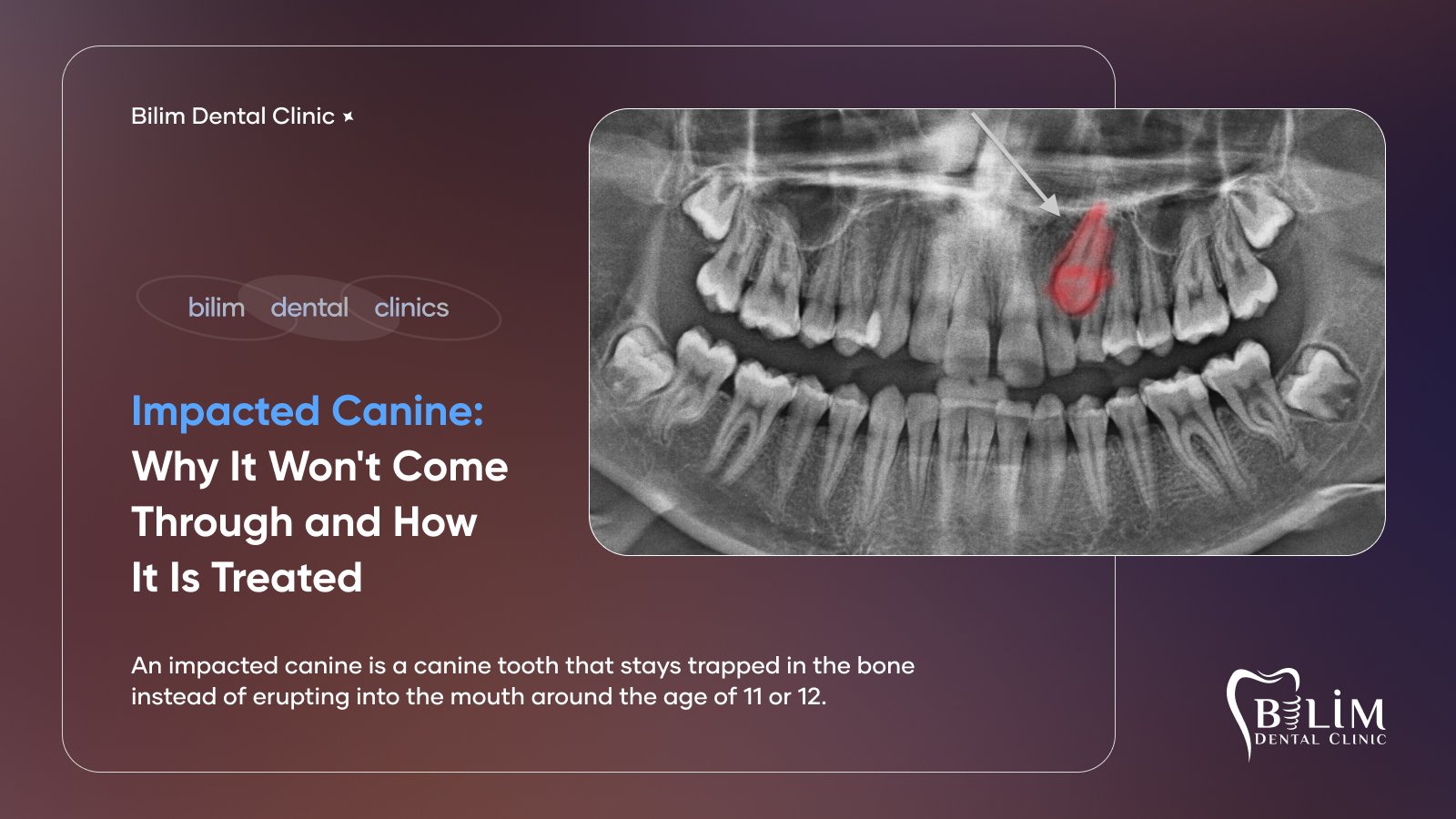
An impacted canine is a canine tooth that stays trapped in the bone instead of erupting into the mouth around the age of 11 or 12. After wisdom teeth, the upper canine is the tooth most often impacted. Families usually discover it when a baby canine is still firmly in place at 13 or 14, or when an x-ray is taken at an orthodontic consultation.
Canines are the cornerstones of the smile. They have the longest roots in the mouth and play an important role in both appearance and in guiding the jaw as it moves. That is why an impacted canine is rarely just “left where it is”; where possible, it is brought into the mouth.
In this article, the dentists at Bilim Dental Clinic in Maltepe, Istanbul explain why canines become impacted, how the problem is diagnosed, why early action makes such a difference, and what the treatment options are.
Why Does a Canine Become Impacted?
The upper canine follows one of the longest eruption paths of any tooth. It begins developing high up, near the base of the eye socket, and travels down over several years. On such a long journey, it is more likely than other teeth to lose its way or meet an obstacle.
The main causes are:
Lack of space: if the jaw is not wide enough and neighbouring teeth fill the space first, the canine has nowhere to go.
A baby canine that stays too long: if the baby tooth does not fall out on time, the path can be blocked.
Small or missing lateral incisors: the root of the lateral incisor acts as a guide for the erupting canine. When the lateral incisor is missing or small (peg-shaped), the canine can lose its way — a link seen especially with canines impacted on the palate side.
Genetics: impacted canines run in some families and can occur alongside other dental anomalies.
An extra tooth or cyst: something in the eruption path can block it.
Abnormal development position: in some cases the tooth bud forms at the wrong angle from the start.
How Is an Impacted Canine Detected?
There is usually no pain, so it is most often found at routine examinations. These signs should raise suspicion:
- A baby canine still firm at age 13–14
- One canine erupted while the other side has not appeared for more than six months
- A hard bulge on the palate or the lip side of the gum
- A lateral incisor tilting sideways, or a gap opening between the front teeth
- At 10–11, the absence of the canine bulge that can normally be felt on the lip side
Diagnosis is confirmed with an x-ray. A panoramic film shows whether the tooth is present and roughly where. For treatment planning, a 3D CBCT scan is usually needed, because only this shows clearly whether the tooth lies on the palate or lip side, how close it is to the roots of neighbouring teeth, and whether it is causing root resorption.
Why Early Detection Matters
With an impacted canine, timing directly determines how complex treatment will be.
If, between about 10 and 13, the canine is seen to be heading the wrong way, removing the baby canine in suitable cases can allow the permanent canine to correct its own path. Simple orthodontic steps such as widening the upper jaw sometimes accompany this. It does not work in every case, but when it does, surgery may be avoided entirely.
If treatment is delayed:
- The canine can press on the roots of neighbouring incisors and cause root resorption, which progresses silently and can lead to loss of the incisor
- A cyst can form around the tooth
- The tooth can settle deeper into the bone, making it harder to bring into the mouth
- In adulthood, treatment takes longer and is less likely to succeed
That is why orthodontic organisations recommend a first orthodontic assessment for every child at around age seven, with canine position monitored particularly from about age ten. See our orthodontic treatment page for more.
Impacted Canine Treatment Options
Treatment depends on the patient’s age, the position and depth of the tooth, root development, and its relationship to neighbouring teeth.
| Option | What Is Done | Suitable For |
|---|---|---|
| Monitoring and interceptive extraction | The baby canine is removed and the permanent canine’s path monitored | Children aged 10–13 with a favourable position |
| Surgical exposure + orthodontic traction | The tooth is uncovered surgically, an attachment bonded, and it is gently pulled into place with braces | The most common approach in teenagers and young adults |
| Exposure and natural eruption | Tissue over the tooth is removed and it is allowed to erupt on its own | Teeth near the surface on the lip side, at a good angle |
| Extraction and space closure | The impacted tooth is removed; the space is closed orthodontically or restored | Teeth that cannot be saved, are causing resorption, or are very badly positioned |
| Monitoring only | The tooth is left in place and checked with regular x-rays | Deep teeth causing no problems, and adults who do not want treatment |
Surgical Exposure and Orthodontic Traction
This is the most common approach. First, orthodontic treatment creates enough space in the arch for the canine. Then a minor surgical procedure uncovers the impacted tooth and a small button or bracket is bonded to it. A fine chain or wire attached to the button guides the tooth slowly into place over several months with controlled forces.
The surgery is done under local anaesthetic, and there may be some pain and swelling for a few days. Moving the tooth into place can take from a few months to a year depending on its position, and the overall orthodontic treatment is usually longer. It requires the oral and maxillofacial surgery and orthodontic teams to work together.
If Extraction Is Needed
If the tooth is very badly positioned, is damaging neighbouring teeth, or the patient is an adult unlikely to respond to treatment, extraction may be advised. The space can then be closed orthodontically or, once growth is complete, restored with an implant or bridge — see our implant treatment page. If the baby canine is healthy with a strong root, in some adults it can continue to function for many years.
Palate Side or Lip Side? Why Position Matters
Most impacted canines lie on the palate side. These are usually deeper and are more often linked to guidance problems, such as a small or missing lateral incisor, than to lack of space. They rarely erupt on their own, so surgical exposure and orthodontic traction are needed more often.
Canines impacted on the lip side are more often caused by crowding. Once enough space is created, some erupt by themselves. Being nearer the surface, they are usually simpler to expose, but careful planning is needed for gum aesthetics — exposure with the wrong technique can leave gum recession after treatment.
Pinpointing the position on a CBCT scan is decisive for planning both the surgical approach and the direction of orthodontic forces. Remember that the two sides of the same mouth can have an impacted canine in different positions.
What Will It Look Like Afterwards?
The question patients ask most is whether the canine will match the other teeth once it is in place. In most cases, with good planning, it achieves a position and appearance in harmony with its neighbours. Sometimes its length, colour, or gum level differs slightly; these small differences can be refined at the end with bonding, gum contouring, or minimal cosmetic work.
Regular follow-up keeps the tooth healthy long-term. The bone and gum around a canine that has been brought into place are monitored with x-rays and clinical checks in the first years.
Impacted Canines in Adults
An impacted canine can be treated in adults too, but as we age the bone becomes denser and teeth are harder to move. After about 30, the chance that the tooth has fused to the bone (ankylosis) increases, in which case orthodontic traction may not be possible.
In adults, the decision considers the tooth’s position, the state of neighbouring teeth, any root resorption, and the patient’s expectations.
Aftercare During Treatment
In the first days after surgical exposure:
- Take prescribed painkillers and, if given, antibiotics as directed
- Use a cold compress on the first day
- Eat soft, lukewarm food
- Clean the surgical area gently as your dentist shows you
- Don’t play with the chain or wire with your tongue or fingers
Regular check-ups during traction are important, because forces are adjusted as the tooth moves. Once it is in place, a retention phase keeps it there.
Does an Impacted Tooth Always Cause Problems?
No. Some impacted canines, especially those deep in the bone and away from other teeth, cause no trouble for years. But to say it is “causing no problems” requires regular x-ray monitoring, because cyst formation and root resorption of neighbouring teeth can progress without symptoms. Even untreated impacted teeth are usually checked every one to two years.
A Simple Checklist for Parents
If your child is between 10 and 12, these observations can help:
- Have the baby canines started to loosen?
- Is there a clear time difference between the canines changing on the two sides?
- Are the upper lateral incisors normal in size, or small and pointed?
- Has a new gap opened between the front teeth?
- Is there a family history of impacted or missing teeth?
If you answer yes to any of these, an orthodontic assessment for an impacted canine is worthwhile. A simple check at a young age can prevent years of treatment later.
Frequently Asked Questions
Will an impacted canine come through on its own?
At a young age and in a favourable position, it may erupt after the baby canine is removed. The older the patient and the worse the angle, the less likely this becomes.
Is it better to remove the tooth or bring it into place?
Because canines matter for appearance and function, bringing them into the mouth is preferred where possible. The tooth’s position and the patient’s age decide.
Is treatment painful?
Surgery is done under local anaesthetic. Mild pain and swelling afterwards usually settle within a few days.
How long does treatment take?
It depends on the tooth’s position; with orthodontics, the whole process often takes 18 months to two and a half years.
At what age should my child be checked?
A first orthodontic assessment around age seven, with canine position monitored particularly from about age ten.
Can adults be treated?
Yes, but success rates are lower than in young patients, and if the tooth has fused to the bone, traction may not be possible.
Can an impacted canine cause a cyst?
Yes. That is why untreated impacted teeth should be monitored with regular x-rays.
What happens if the baby canine stays?
If its root is strong it can function for years, but it may eventually be lost to root resorption, so it needs monitoring.
Is a CBCT scan necessary?
For treatment planning, usually yes. Whether the tooth lies on the palate or lip side and its relationship to neighbouring roots are seen most clearly on CBCT.
Is an impacted canine removed like a wisdom tooth?
No — the first choice is usually to bring it into the mouth. Wisdom teeth are a different case, often removed for other clinical reasons.
Impacted Canine Treatment at Bilim Dental Clinic in Maltepe
An impacted canine is often far simpler to manage when caught early. In this article we answered the questions we are asked most: causes, diagnosis, interceptive extraction, surgical-orthodontic treatment, and the approach in adults. Our orthodontic specialist, Uzm. Dt. Burak Güleç, is introduced on our team page, and missing lateral incisors are discussed in our smile design page.
At our clinic, we provide services in all areas of oral and dental health — from aesthetic dentistry and implant treatments to orthodontics and prosthetic applications — using modern technology and evidence-based, scientific approaches. Our experienced team of dentists creates a personalized treatment plan for every patient, aiming to build healthy, natural, and aesthetic smiles.
The dentists who will accompany you throughout this process:
- Dt. Ali Enes Öztürk
- Dt. Salman Taştan
- Dt. Hüseyin Kaya
- Uzm. Dt. Burak Güleç (Orthodontics Specialist)
- Dt. Cem Karaman
- Dt. Ayşe Sizer Çakar
- Dt. Zeynep Ece Okur (Pediatric Dentist)
For an impacted tooth assessment, contact us or visit us — we invite you to visit Bilim Dental Clinic on Bağdat Caddesi in Maltepe, Istanbul. You can follow our latest updates on our Instagram account.
WhatsApp: +90 538 977 89 01