

Tooth pain in cold weather is one of the most common complaints dentists hear during the winter months. You step outside, take a deep breath or talk into a cold wind, and feel a sharp, brief twinge in your teeth. The most common reason for this is tooth sensitivity, which happens when the dentine beneath …
Tooth pain in cold weather is one of the most common complaints dentists hear during the winter months. You step outside, take a deep breath or talk into a cold wind, and feel a sharp, brief twinge in your teeth. The most common reason for this is tooth sensitivity, which happens when the dentine beneath the tooth’s protective outer layer becomes exposed.
Most of the time this is harmless sensitivity. Sometimes, though, it can be the first sign of a cavity, a cracked tooth or the sinusitis that is so common in winter. In this guide we explain why teeth ache in winter, when the pain should be taken seriously, what you can do at home and which treatments your dentist can offer.
What Causes Tooth Pain in Cold Weather?
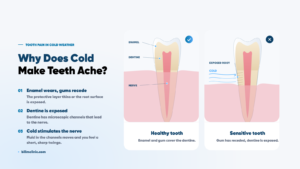
The outer surface of a tooth is covered with enamel, the hardest tissue in the body. Beneath the enamel lies a softer layer called dentine. Dentine contains thousands of microscopic channels, called dentinal tubules, which run towards the nerves at the centre of the tooth. The root surfaces below the gum line are not covered by enamel, only by a much thinner layer.
When enamel wears away or the gums recede, the openings of these tubules become exposed. According to the most widely accepted explanation, the hydrodynamic theory, a cold, hot, sweet or sour stimulus makes the fluid inside the tubules move. This movement stimulates the nerve endings in the tooth and is felt as a short, sharp pain. Cold air works in exactly this way, especially when you breathe through your mouth and the cold air reaches exposed dentine directly.
Reported rates of dentine sensitivity vary enormously between studies. One review notes figures ranging from 1% to 98%, reflecting differences in the age groups studied and the methods used. What is certain is that if your teeth ache in winter, you are far from alone.
Common Reasons Teeth Become Sensitive in Winter

Cold weather is rarely the problem itself. More often it is the trigger that reveals sensitivity that was already there. The main reasons dentine becomes exposed, or a tooth becomes vulnerable to cold, are:
- Gum recession: When the gums pull back, the root surface that is normally covered by gum becomes exposed. Because the root is not covered by enamel, it is much more sensitive to cold.
- Brushing too hard: Using a hard-bristled brush or pressing hard while brushing can wear away enamel and contribute to gum recession.
- Acidic food and drinks: Citrus fruits, fruit juices, fizzy drinks and foods containing vinegar can gradually erode enamel. Lemon tea and citrus fruit, both popular in winter, belong in this group.
- Clenching and grinding: Clenching or grinding your teeth at night or during the day can wear down enamel and lead to sensitivity.
- Tooth decay: When a cavity that starts in the enamel reaches the dentine, the tooth becomes sensitive to cold. That is why new sensitivity in a single tooth should always be checked.
- Cracked or chipped teeth and worn fillings: Cracks and old fillings that leak around the edges make it easier for cold to reach the inside of the tooth.
- Gum disease: Advancing gum disease can expose root surfaces.
- Teeth whitening and recent treatment: Sensitivity after whitening, a filling or a scale and polish is usually temporary.
Why Sinus-Related Tooth Pain Increases in Winter
Colds and flu are more common in winter, and the sinusitis that can follow them may also cause pain in the upper teeth. The roots of the upper back teeth sit very close to the maxillary sinus behind the cheekbone, and in some people they extend right into the sinus cavity. According to Mayo Clinic, pain in the upper back teeth is a fairly common symptom of sinus conditions.
Sinus-related tooth pain often has these features:
- The pain feels spread across several upper back teeth rather than in one tooth.
- It comes with a blocked or runny nose and a feeling of fullness or pressure in the face.
- It started after a cold or flu.
Even so, the cause of tooth pain cannot be identified reliably from symptoms alone. The recommended approach is to see a dentist first, to rule out dental causes such as decay, gum disease or infection. If your teeth are healthy, see your doctor about a possible sinus problem.
Sensitivity or Something More Serious?

Not every pain triggered by cold means the same thing. How long the pain lasts, where you feel it and what set it off all give useful clues. A dental professor at Texas A&M University describes cold as a good test of whether teeth are healthy. He points out that if severe pain continues after the cold is removed, it may indicate irreversible pulp (nerve) disease that needs root canal treatment.
| Dentine sensitivity | Decay or nerve inflammation | Sinus-related pain | |
|---|---|---|---|
| Type of pain | Short, sharp twinge | Throbbing, getting worse | Dull, pressure-like |
| How long it lasts | Fades within seconds once the cold is gone | Continues after the cold is gone | Can last for hours or days |
| Where | One or a few teeth, often at the gum line | Usually one tooth | Several upper back teeth |
| Other signs | Usually none | Night pain, swelling, pain when chewing | Blocked nose, facial pressure |
| What to do | Sensitive toothpaste and a dental check-up | See a dentist promptly | Dentist first, then a doctor if needed |
This table is only a general guide. Dentine sensitivity is diagnosed after decay, cracks and other causes have been ruled out, so a proper assessment always requires an examination.
How to Ease Tooth Pain in Cold Weather

For mild sensitivity, a few small changes to your daily habits can make a noticeable difference:
- Breathe through your nose outdoors. Air breathed in through the nose is warmed before it reaches your mouth, so cold air does not hit your teeth directly.
- Cover your mouth with a scarf. On cold, windy days a scarf or snood reduces how much cold air reaches your teeth.
- Use a toothpaste made for sensitive teeth. These toothpastes can help when used regularly, although it may take a few weeks to notice the effect.
- Use a soft-bristled brush and brush gently. Pressing hard and scrubbing side to side puts strain on enamel and gums.
- Brush with lukewarm water if your teeth are sensitive to cold. Cold water can set off a twinge while you brush.
- Rinse with water after acidic food and drinks. Drinking acidic drinks through a straw also reduces contact with your teeth.
- Avoid going straight from very hot to very cold. For example, drinking iced water right after hot tea can be hard on sensitive teeth.
- Talk to your dentist if you clench your teeth. If you grind your teeth at night, a custom-made night guard may be recommended.
If there is no improvement within a few weeks despite these steps, see a dentist rather than continuing to treat it at home. Sensitive toothpaste can ease the pain, but it does not treat an underlying cavity or crack.
Which Treatments Can Your Dentist Offer?
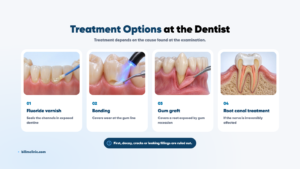
Treatment depends on the cause found during the examination. The first step is to find out whether a problem such as decay, a crack or a leaking filling is causing the sensitivity. If so, that problem is treated first.
The main treatments for dentine sensitivity are:
- In-surgery desensitising products: Fluoride-containing gels, solutions or varnishes are applied to the exposed dentine. They block the openings of the dentinal tubules and reduce fluid movement.
- Bonding and protective coatings: Exposed dentine, particularly where teeth are worn at the gum line, can be covered with tooth-coloured filling material or dental adhesives.
- Gum grafts: If sensitivity is caused by gum recession, a gum graft may be considered to cover the exposed root surface.
- Root canal treatment: For severe pain that does not respond to other treatments, or when the nerve of the tooth is irreversibly affected, root canal treatment may be needed.
Dealing with the cause is just as important to stop sensitivity coming back. Correcting brushing technique, cutting down on acidic foods and managing clenching all help treatment last.
When Should You See a Dentist?

Tooth pain in cold weather is usually not an emergency. Even so, see your dentist without delay if you notice any of the following:
- Pain that lasts for minutes after the cold is gone
- Pain that starts on its own, throbs or wakes you at night
- Sharp pain when chewing or biting
- Swelling in the gum or face, fever, or a bad taste in your mouth
- New sensitivity in a single tooth that keeps getting worse
- Symptoms that have not improved after a few weeks of sensitive toothpaste
Regular dental check-ups allow decay and gum problems that can cause sensitivity to be caught early. A check-up at the start of winter can help you get through the cold months more comfortably.
Frequently Asked Questions
Is it normal for my teeth to hurt in cold weather?
A brief, mild twinge in cold air is very common and is usually caused by dentine sensitivity. If the pain lasts a long time, started in a single tooth or keeps getting worse, see a dentist, as it may be a sign of decay or a crack.
Why do only my upper teeth hurt in winter?
The roots of the upper back teeth sit very close to the maxillary sinus. Sinusitis after a cold or flu can cause pain in these teeth. If the pain spreads across several upper back teeth and comes with a blocked nose, sinusitis is a possibility. Dental causes should still be ruled out first.
How long does sensitive toothpaste take to work?
It varies from person to person and can take a few weeks. For the best results the toothpaste needs to be used regularly. If your sensitivity has not eased after a few weeks of use, see your dentist.
Can cold weather damage my teeth?
Cold air does not damage healthy teeth. In most cases it simply makes an existing problem noticeable, such as sensitivity, exposed dentine or a cavity. That is why sensitivity that starts in winter is a good reminder to have your teeth checked.
My teeth also hurt with hot tea. What does that mean?
Dentine sensitivity can also be triggered by heat. However, pain that starts with something hot and lingers may indicate inflammation of the tooth’s nerve. In that case you should have your tooth examined promptly.
Does teeth whitening make cold sensitivity worse?
Some people notice sensitivity after whitening, and it is usually temporary. If your teeth are already sensitive, it is worth discussing this with your dentist before whitening.
Can children get tooth pain in cold weather?
Yes. One of the most common causes of cold-triggered tooth pain in children is decay. If your child complains of tooth pain with cold food and drinks or in cold weather, take them to a paediatric dentist.
Does sensitivity go away completely?
When the cause is correctly identified and treated, sensitivity usually eases significantly or disappears. It can come back if triggers such as brushing habits or diet continue.
Treatment for Sensitive Teeth and Toothache in Maltepe, Istanbul
Aching teeth in winter are not something you simply have to live with. Once the cause of the sensitivity is found, relief is often possible with simple, short treatments. The first step is a thorough examination of your teeth and gums.
If you are travelling from abroad, you can contact us on WhatsApp before your visit to plan your appointment.
At Bilim Dental Clinics, our goal is to create a natural and balanced smile that truly feels like yours.
Our clinic provides care in every area of oral and dental health, from cosmetic dentistry and implant treatment to orthodontics and prosthetics, using modern technology and a scientific approach. Our experienced team of dentists plans each treatment individually, with the aim of creating healthy, natural and beautiful smiles.
The dentists who will accompany you through this process:
- Dt. Ali Enes Öztürk
- Dt. Salman Taştan
- Dt. Hüseyin Kaya
- Spec. Dt. Burak Güleç (Orthodontist)
- Dt. Cem Karaman
- Dt. Ayşe Sizer Çakar
- Dt. Zeynep Ece Okur (Paediatric Dentist)
WhatsApp → +90 538 977 89 01
Bilim Dental Clinics | Istanbul
Natural. Harmonious. Flawless.


