Dental trauma almost always happens when you least expect it: a child falling off a bike, an elbow during a football match, a slip on a wet floor, or biting down on something hard. Panic is natural in these moments, but what happens in the next few minutes largely decides whether the tooth can be …
Dental trauma almost always happens when you least expect it: a child falling off a bike, an elbow during a football match, a slip on a wet floor, or biting down on something hard. Panic is natural in these moments, but what happens in the next few minutes largely decides whether the tooth can be saved.
A broken tooth and a knocked-out tooth are different situations, but timing matters in both. For a permanent tooth that has been completely knocked out, time is critical. A tooth that is stored correctly and replanted quickly can remain in the mouth for many years. A tooth left dry or kept waiting for hours has a much lower chance of success.
In this article, the dentists at Bilim Dental Clinic in Maltepe, Istanbul explain what to do in the first minutes, how to store a tooth, which mistakes to avoid, and when to go to a hospital instead.
First: Hospital or Dentist?
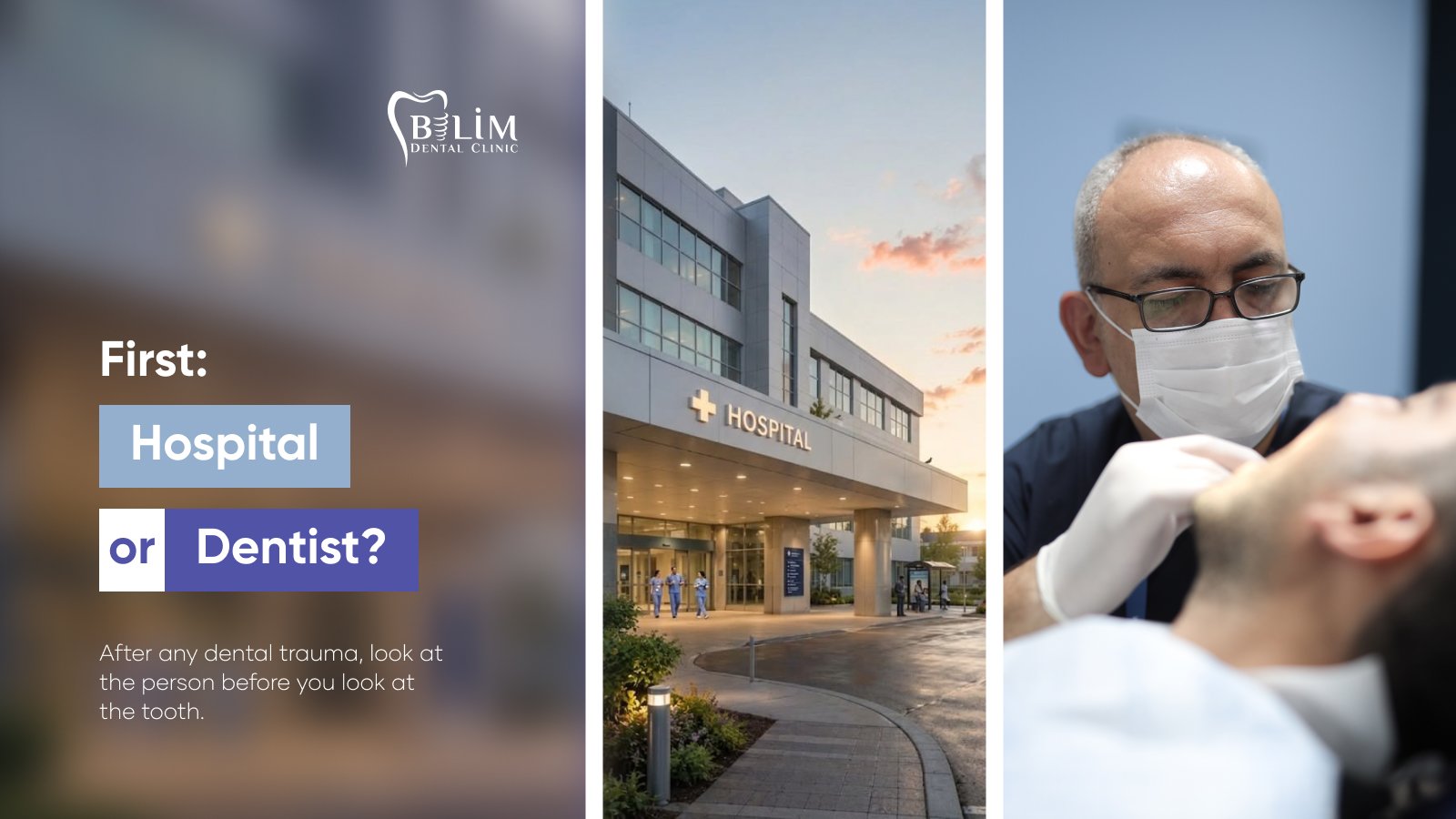
After any dental trauma, look at the person before you look at the tooth. Go to a hospital emergency department without delay if there is:
- Loss of consciousness, dizziness, vomiting, or headache (possible head injury)
- Bleeding that will not stop
- Difficulty breathing or swallowing
- A jaw that will not close, a visibly misshapen jaw, or serious facial injury (possible jaw fracture)
- Neck pain
If none of these are present, the first stop for dental trauma is a dentist. If it happens outside normal hours, reaching an on-call dental clinic saves valuable time.
Types of Dental Trauma
Not every case of dental trauma is the same, and what you should do depends on the type.
| Type of Injury | What Happens | First Step | Urgency |
|---|---|---|---|
| Enamel crack | Fine line on the surface, no tooth lost | Routine check-up | Low |
| Crown fracture – nerve not exposed | Tip of the tooth breaks off; may be sensitive | Keep the fragment in milk or water | Same or next day |
| Crown fracture – nerve exposed | Pink-red dot on the broken surface, bleeding | Press gently with clean gauze; see a dentist | Within a few hours |
| Root fracture | Tooth looks intact but is loose or painful | Leave it alone; see a dentist | Same day |
| Displacement (luxation) | Tooth pushed in, out, or sideways | Do not force it; see a dentist | Within a few hours |
| Knocked out (avulsion) | Tooth completely out of its socket | Replant or store in milk | Within minutes |
Knocked-Out Tooth: 7 Steps in the First 60 Minutes
 A knocked-out permanent tooth is one of the true emergencies in dentistry. The thin layer of cells covering the root must stay alive for the tooth to reattach, and these cells die quickly when dry. According to the International Association of Dental Traumatology, the chance of success is highest when the tooth is replanted within about 15 minutes; once the tooth has been dry for more than 60 minutes, those cells are unlikely to survive.
1. Find the tooth and hold it by the crown. Hold the white part normally visible in the mouth. Never touch the root — its living cells are easily damaged.
2. If dirty, rinse very briefly. If the tooth has touched soil or dirt, rinse it gently for a few seconds with milk, saline, or the person’s own saliva. Avoid holding it under tap water for long. Do not scrub, wipe, or use soap on the root.
3. Replant it straight away if possible. If the person is conscious and cooperative, gently push the tooth back into its socket facing the right way — it should line up with the teeth beside it.
4. Bite on a clean cloth. Have the person bite gently on a clean handkerchief or gauze to hold the tooth in place.
5. If you cannot replant it, store it correctly. Place the tooth in a glass of cold milk. If there is no milk, use saline. If neither is available, an adult can hold the tooth between the cheek and gum — but not a young child, because of the risk of swallowing it.
6. Never let it dry out. Wrapping the tooth in a tissue, putting it in a pocket, or carrying it in a dry container is the most common and most harmful mistake.
7. Go to a dentist immediately. Even a replanted tooth needs to be checked, stabilised, and followed up.
A Knocked-Out Baby Tooth Is Not Replanted
This distinction is essential. A baby tooth that has been knocked out should not be put back, because replanting it can damage the developing permanent tooth underneath.
If a baby tooth is knocked out:
- Control bleeding by pressing gently with a clean cloth
- Keep the tooth and show it to the dentist, so they can confirm it came out completely
- See a dentist the same day
The dentist will check the permanent tooth below and may recommend a space maintainer.
As a rough guide: in children under six, the front teeth are usually baby teeth; after about seven or eight, they are usually permanent. If you are not sure, keep the tooth in milk and see a dentist straight away.
What to Do for a Broken Tooth
When dental trauma breaks off only part of a tooth, the situation is usually less urgent — but it is still best to be seen the same day.
Find and keep the fragment. Stored in water or milk, a broken piece can sometimes be bonded back onto the tooth, which gives the most natural result.
Rinse with warm water. If there is bleeding, press gently with clean gauze.
Use a cold compress. If the lip or cheek is swollen, apply ice from the outside.
Watch for sensitivity. A pink-red spot on the broken surface means the nerve is exposed. See a dentist promptly; timely treatment can preserve the nerve.
Painkillers: if needed, take a painkiller you have used before without problems, following the label. Never place a tablet on the gum or tooth — it burns the tissue.
If the Tooth Has Been Pushed Out of Position
If the tooth has not come out but has been pushed in, pushed out, tilted, or is loose — known as luxation:
- Do not try to push it back yourself
- Avoid biting on that side
- See a dentist within a few hours
The dentist will reposition the tooth and attach it to neighbouring teeth with a flexible splint while it heals, usually for a few weeks.
What Happens at the Dentist After Dental Trauma?
The dentist first assesses the full extent of the injury: soft tissue wounds, the jawbone, neighbouring teeth, and the teeth in the opposite jaw. X-rays show any root fracture, bone damage, or displacement.
Replanted or displaced teeth are splinted to neighbouring teeth so they stay still while healing. Antibiotics may be prescribed, and tetanus status is checked — particularly if the tooth touched soil.
Most replanted permanent teeth with fully formed roots will need root canal treatment in the following days, because the nerve cannot survive. In young teeth whose roots are still developing, the nerve may recover on its own, so close monitoring may be preferred.
Treatment Options for a Broken Tooth
How a broken tooth is restored depends on the size of the fracture, whether the nerve is involved, and the patient’s age:
Reattaching the fragment: if it was kept and is intact, it can be bonded back, preserving the tooth’s own colour and texture.
Rebuilding with composite: small and medium fractures can be restored in a single visit with tooth-coloured composite filling material, with almost no removal of healthy tooth.
Root canal treatment: if the fracture reaches the nerve, or the nerve later dies. In young patients, techniques that preserve part of the nerve may be used so the root can finish developing.
A crown: if much of the tooth is lost, or it is weak after root canal treatment, a zirconia crown may be recommended. In teenagers who are still growing, permanent crowns are usually postponed.
Extraction and replacement: vertical fractures running down the root often mean the tooth cannot be saved.
The right option is chosen after examination and x-rays. Being seen on the same day keeps more options open.
Why Follow-Up Matters
Dental trauma does not end on the day of the accident. Some problems appear weeks or even months later:
- Darkening of the tooth (possibly a sign the nerve has died)
- An abscess or swelling near the root
- Root resorption
- The tooth fusing to the bone
Teeth affected by dental trauma are therefore reviewed at intervals your dentist sets — typically after a few weeks, a few months, and a year. Attending even without symptoms allows problems to be caught early.
Dental Trauma in Children and Sport
Dental trauma is most common in toddlers aged two to four (learning to walk) and in school-age children aged eight to twelve (play, cycling, sport). In teenagers and adults, sports injuries, traffic accidents, and fights dominate.
In children, dental trauma to a baby tooth can affect the permanent tooth developing beneath it, so follow-up matters even for baby teeth. Months later, the permanent tooth may show colour or shape changes.
For athletes, a custom-made mouthguard is the most effective protection. Patients with braces are at higher risk of lip and cheek injury, so suitable guards are recommended for them too. Simply making sure coaches and teachers know that a knocked-out tooth belongs in milk can save many teeth.
If the Tooth Cannot Be Saved
Despite every effort, some teeth cannot be saved after dental trauma, or are lost later. Even then there are solutions. In adults, implant treatment, bridges, or adhesive bridges can be considered. In growing children and teenagers, implants are usually postponed until growth is complete, and the space is maintained with temporary solutions.
Even a replanted tooth that may eventually be lost often helps preserve bone volume, making future treatment easier. That is why replanting is usually the right decision even when the tooth has been out for a long time.
Preventing Tooth Injuries
- Wear a mouthguard for basketball, football, martial arts, hockey, cycling, and skateboarding
- Treat protruding front teeth — children with prominent upper front teeth are more prone to injury, and orthodontic treatment reduces the risk
- Don’t use your teeth as tools — opening bottles, chewing pens, or cracking nuts are common causes of fractures
- Child-proof your home — stair gates and corner guards are simple but effective
Frequently Asked Questions
How soon must a knocked-out tooth be replanted?
Ideally within 15 minutes. Stored in milk or saline, the window is longer; a tooth left dry for more than 60 minutes has a much lower chance of success. Even so, take it to a dentist.
Can I store the tooth in water?
Tap water damages the root cells, so it is not ideal. Milk, saline, or the person’s own saliva is better. If none is available, water is still better than leaving the tooth dry.
Can a broken piece be reattached?
Often, yes, if the fragment is intact. Bringing it in milk or water improves the chances.
If a broken tooth doesn’t hurt, can I wait?
No pain does not mean the nerve is healthy. Broken teeth should be seen the same day or the next day at the latest.
Why has the tooth turned darker after an injury?
Darkening can mean the nerve has been damaged. A check-up and, if needed, root canal treatment will be planned.
My child’s baby tooth was knocked out — should I put it back?
No. Baby teeth are not replanted, as this can damage the permanent tooth. Keep the tooth and see a dentist the same day.
Is a tetanus shot needed?
It may be if the tooth touched soil and your vaccinations are not up to date. Your dentist or doctor will advise.
Will a broken tooth need a crown?
It depends on the size of the fracture. Small fractures can be restored with composite; larger losses may need a crown.
Do mouthguards really work?
Yes. In contact sports especially, mouthguards significantly reduce the risk of dental and jaw injury.
How long should I eat soft food after dental trauma?
Usually for the first one to two weeks, especially if a splint is in place. Your dentist will confirm.
Dental Trauma Care at Bilim Dental Clinic in Maltepe
After dental trauma, time is the single most important factor in the outcome. In this article we answered the questions people ask most: how to store a tooth, the difference between baby and permanent teeth, when to go to hospital, and why follow-up matters. You can check our opening times on the working hours page.
At our clinic, we provide services in all areas of oral and dental health — from aesthetic dentistry and implant treatments to orthodontics and prosthetic applications — using modern technology and evidence-based, scientific approaches. Our experienced team of dentists creates a personalized treatment plan for every patient, aiming to build healthy, natural, and aesthetic smiles.
The dentists who will accompany you throughout this process:
- Dt. Ali Enes Öztürk
- Dt. Salman Taştan
- Dt. Hüseyin Kaya
- Uzm. Dt. Burak Güleç (Orthodontics Specialist)
- Dt. Cem Karaman
- Dt. Ayşe Sizer Çakar
- Dt. Zeynep Ece Okur (Pediatric Dentist)
If you have had a dental injury, contact Bilim Dental Clinic on Bağdat Caddesi in Maltepe, Istanbul for a prompt assessment. You can follow our latest updates on our Instagram account.
WhatsApp: +90 538 977 89 01